The New Education Policy landed in 2020 and produced the usual storm — editorials, Twitter debates, anxious WhatsApp forwards from parent groups. Four years later, the dust has settled enough to actually assess what’s changed, what’s still in progress, and what it means practically for your child in a CBSE school.
It’s a big policy. Let’s not pretend to cover all of it. Instead — the parts that actually affect daily school life.
The New Education Policy (NEP 2020) is transforming CBSE schools with changes in curriculum structure, assessment methods, and vocational education. This guide explains how these reforms impact students and parents.
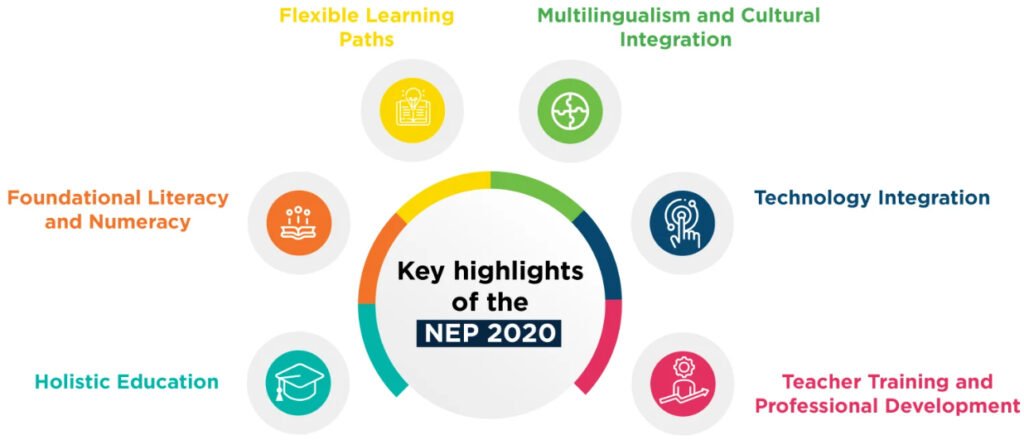
Understanding the New Education Policy in CBSE Schools
The New Education Policy is reshaping CBSE schools by focusing on conceptual learning, flexibility, and overall student development
The Structural Shift: 5+3+3+
The New Education Policy introduces the 5+3+3+4 structure, bringing a major shift in school education.
The old 10+2 structure is being phased out in favour of a 5+3+3+4 model:
• Foundational stage (3-8 years): Nursery through Class 2
• Preparatory stage (8-11 years): Classes 3-5
• Middle stage (11-14 years): Classes 6-8
• Secondary stage (14-18 years): Classes 9-12
What this means in practice: the foundational years are now formally recognised as part of school education. Play-based learning, mother-tongue instruction, and holistic development are not just nice ideas — they’re policy mandates.
For CBSE schools, this has begun to translate into revised curricula in primary classes, updated NCERT textbooks, and a gradual shift away from purely rote-based assessment.
Assessment Reform
A key feature of the New Education Policy is the shift toward competency-based and continuous assessment.
This is where NEP 2020 changes hit classrooms most visibly. The policy pushes toward:
• Continuous and comprehensive evaluation over single high-stakes exams
• Competency-based questions that test understanding, not recall
• Portfolio assessments, project work, and oral evaluations gaining formal weight
• Board exams eventually offered twice a year to reduce one-shot pressure
With the New Education Policy focusing on conceptual learning, students preparing for competitive exams can benefit from structured guidance like Best School for JEE Preparation How To.
CBSE has already revised its Class 10 and 12 assessment patterns — two-term exams, increased internal assessment weightage, more application-based questions. Teachers are being trained — gradually, unevenly — to assess differently.
The transition is messy, as all transitions are. Some schools have genuinely embraced the spirit of the change. Others have repackaged the same content in new formats and called it NEP-compliant. Your job as a parent is to ask which your school is doing.

Mother Tongue and Multilingualism
The New Education Policy promotes multilingual education and encourages mother-tongue learning in early years.
NEP implementation in CBSE schools includes the three-language formula and a push toward instruction in the mother tongue until Class 5 wherever feasible. This is culturally significant. Cognitively, there’s solid research showing that children learn conceptually better in their first language.
In practice, private CBSE schools — especially English-medium ones — are navigating this cautiously. Complete mother-tongue medium instruction may not happen in all schools, but regional language strengthening is happening through dedicated periods, literature inclusion, and reduced stigma around multilingualism.
Vocational Education from Class 6
Skill development is a core focus of the New Education Policy, with vocational education starting from Class 6.
One of the more interesting — and underreported — aspects of NEP 2020 is the integration of vocational skills into school curriculum from Class 6 onwards. Coding, agriculture, carpentry, handicrafts. Not as career training but as exposure. As respect for work done with hands.
Some CBSE schools have begun partnerships with ITI colleges and local artisans. Others are still figuring out logistics. The intent is worth watching — it’s a philosophical shift about what education is for.
What Parents Should Do Right Now
Parents should understand the New Education Policy to make informed decisions about their child’s education.
The policy is aspirational. Implementation is variable. The gap between what NEP says and what happens in any given classroom is still significant. So:
• Ask your child’s school specifically what NEP 2020 changes they’ve implemented and when
To better understand the admission process under changing education policies, parents can also explore Top School Admission Questions.
• Look at Class 9 and 10 report cards — are they using competency-based language or the same old marks?
• Attend parent meetings. The schools that are genuinely implementing NEP will talk about it with detail, not vague enthusiasm
• Don’t assume change is happening just because the school updated its brochure
The Long View
Education reform in India has a history of ambitious policy and slow change. NEP 2020 is genuinely more thoughtful than most of what preceded it — the emphasis on holistic development, reduced curriculum load, multiple pathways, and lifelong learning reflect something true about what children need.
But it will take years, maybe a decade, to fully manifest at the classroom level. What’s encouraging is that CBSE has been more proactive than most boards in attempting alignment. The revised NCERT textbooks, updated question papers, and training initiatives are real, even if incomplete.
Conclusion
NEP 2020’s impact on CBSE schools is real and ongoing. The shift is away from memorisation toward understanding, away from one-size assessment toward multiple pathways, away from English-only toward multilingual recognition. For parents, the most important question isn’t “is my school NEP-compliant” — it’s “is my school actually teaching my child to think.” That’s what the policy is reaching for.
FAQs
Q1: Is NEP 2020 fully implemented in CBSE schools?
Not fully. Implementation is ongoing and varies by school. Core structural changes are in place, but complete alignment — especially in pedagogy and assessment — will take several more years.
Q2: Will the 10+2 board exam structure be eliminated?
The structure is being reshaped, not eliminated. Board exams will continue but with revised formats — eventually offered twice a year and with stronger internal assessment components.
Q3: How does NEP 2020 affect Class 10 exams?
CBSE has already restructured Class 10 assessments to include more competency-based questions, practical components, and internal marks. The trend continues.
Q4: What is the three-language formula under NEP?
Students are expected to learn three languages — typically Hindi, English, and a regional language — with an emphasis on mother-tongue instruction in early years.
Q5: How can parents evaluate if a school is genuinely implementing NEP?
Ask about specific changes to curriculum, assessment methods, and teacher training. Vague answers suggest surface compliance; specific processes suggest genuine engagement.