There is something oddly emotional about school admissions. People say it’s just paperwork. Just forms. Just documents. But anyone who has ever sat late at night with a laptop open, ten tabs running, comparing schools, reading admission criteria again and again… knows it doesn’t feel like paperwork. It feels like the beginning of something. A small decision that somehow carries the weight of a child’s future.
Oxford School is known for providing a structured and transparent admission process along with a strong academic environment for students. You can learn more about the school and its approach here.

And CBSE School Admission 2026 is already on many parents’ minds. Earlier than expected, honestly. But that’s how things are now. Applications open earlier. Seats fill faster. Schools update policies quietly. And parents… well, parents keep searching.
Some are applying for nursery admissions. Some are shifting schools because of relocation. Some are looking for better academic environments. Others are thinking long term — entrance exams, competitive exams, the kind of foundation a curriculum creates.
So this Complete Guide to CBSE School Admission 2026 isn’t meant to feel like a rigid checklist. Think of it more like someone walking you through the process. Slowly. Honestly. A bit imperfectly.
Because the admission journey rarely goes exactly as planned.
CBSE school admission 2026 includes application forms, eligibility criteria, document submission, interaction rounds, and final admission confirmation based on school guidelines.
Understanding the CBSE Admission System
Before filling forms or collecting documents, it helps to pause for a moment and understand how the CBSE School Admission 2026 system actually works.
CBSE itself doesn’t conduct admissions. That part surprises many parents.
The Central Board of Secondary Education sets the curriculum and academic framework, but individual schools manage their own admission processes. Which means two CBSE schools in the same city may follow slightly different rules.
Some schools prioritize neighborhood students.
Some conduct interaction rounds.
Some have entrance tests for higher classes.
The board provides structure. The schools manage the entry door.
Typically, CBSE admissions fall into a few categories:
• Nursery / Pre-Primary admissions
• Primary school admissions (Class 1–5)
• Middle school transfers (Class 6–8)
• Secondary admissions (Class 9 onwards)
Each stage carries slightly different requirements. Not dramatically different. But enough to confuse parents if they are navigating the system for the first time.
And confusion often begins with the timeline.
When CBSE School Admission 2026 Forms Usually Open
Admission timelines can vary between schools, but patterns appear if you observe carefully.
For CBSE School Admission 2026, most schools begin the process between November 2025 and February 2026. Nursery admissions often open first.
Parents who wait until March usually discover something frustrating.
Many good schools have already closed applications.
Typical admission cycle looks like this:
November – December
• Nursery and KG admission announcements
• Online application forms released
• School open houses or orientation sessions
January – February
• Shortlisting of candidates
• Parent-child interaction rounds
• Document verification
March – April
• Final admission lists released
• Fee payment deadlines
• Academic session preparation
Of course, transfers and admissions to higher classes sometimes happen later if seats become available.
Still, one quiet truth most parents eventually learn…
Early awareness reduces stress dramatically.
Eligibility Criteria for CBSE School Admission 2026
Eligibility is where things get oddly specific.
Not complicated exactly. Just… precise.
For example, age rules.
Schools usually follow standard age guidelines for entry classes:
Typical Age Criteria
• Nursery – 3 years
• LKG / Pre-Primary – 4 years
• UKG – 5 years
• Class 1 – 6 years
But the cut-off date matters. Some schools consider 31 March, others follow 30 September depending on local education regulations.
For higher classes, eligibility is based on:
• Previous class completion
• Transfer certificate
• Academic records
• Sometimes entrance assessments
Many CBSE schools also consider a few preference factors:
• Sibling studying in the school
• Distance from residence
• Alumni parents
• Staff wards
Not every school uses these categories. But many do.
Which means admission decisions are sometimes a mix of eligibility and availability.
Documents Required for School Admission
This part feels boring until the moment a missing document delays the application.
During CBSE School Admission 2026, schools usually ask for a fairly standard set of documents. Nothing too unusual. But everything must be organized.
Commonly required documents include:
• Birth certificate of the child
• Recent passport size photographs
• Aadhar card of the child and parents
• Residence proof
• Previous school report card
• Transfer certificate (for higher classes)
• Vaccination records (sometimes for pre-primary)
• Parent identity proof
Some schools also ask for:
• Income certificate
• Caste certificate (if applicable)
• Medical records
The trick most experienced parents follow is simple.
Create one admission folder.
Digital copies. Physical copies. Everything ready before forms open.
Because once application deadlines start approaching, calm preparation quietly turns into chaos.
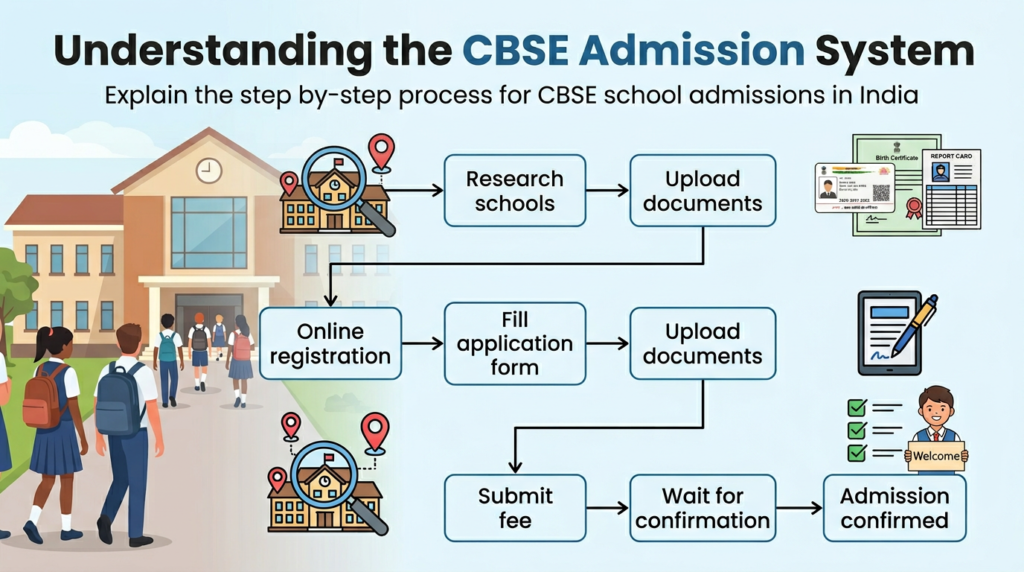
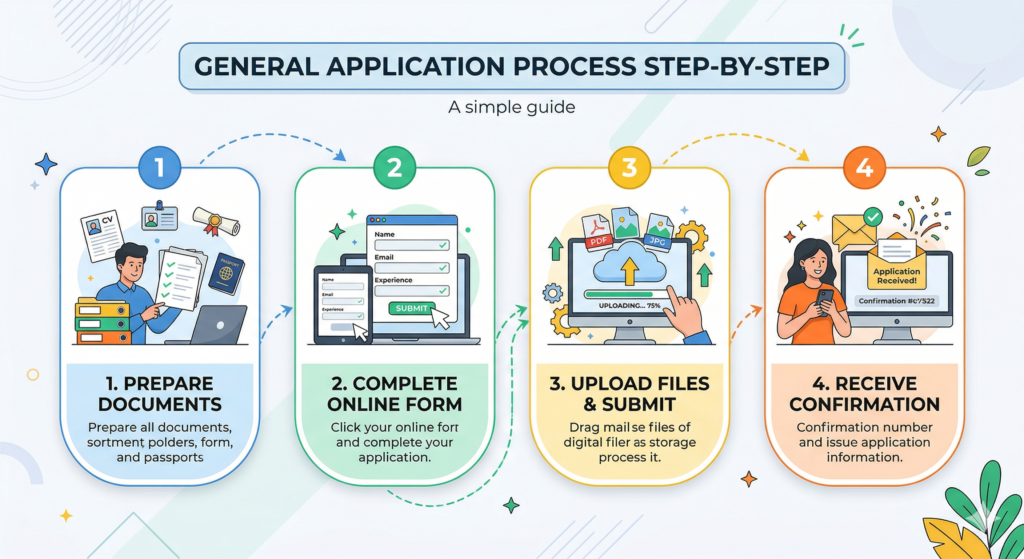
The Application Process Step by Step
The CBSE School Admission 2026 process usually follows a predictable path. But when you’re inside it, it can feel scattered.
So it helps to visualize the steps clearly.

Step 1 – Research Schools
Parents usually shortlist schools based on:
• Location
• Academic reputation
• Facilities
• Board results
• Fee structure
Sometimes it takes weeks to narrow this down.
Step 2 – Fill the Application Form
Most CBSE schools now use online admission forms.
Forms usually ask for:
• Child details
• Parent details
• Educational history
• Contact information
Accuracy matters. Small errors create unnecessary complications.
Step 3 – Submit Documents
After submitting the form, schools often request supporting documents for verification.
This may happen online or physically at the school campus.
Step 4 – Interaction or Assessment
For nursery admissions, schools often conduct a parent-child interaction.
For higher classes, there might be:
• Basic written tests
• Subject assessments
• Informal interviews
Not every school conducts tests. But many do.
Step 5 – Admission Confirmation
If selected, parents receive an admission confirmation email or notice.
Then comes the final step.
Fee payment.
Which usually has strict deadlines.
If you want a detailed breakdown of each step involved in school admissions, you can explore this complete step-by-step guide for parents.
How to Choose the Right CBSE School
This question quietly sits behind the entire CBSE School Admission 2026 process.
Which school is actually right?
Parents often look at rankings first. Infrastructure second. Board results third.
But sometimes the right school is something less obvious.
Something about environment.
Some questions worth asking during school visits:
• Do teachers seem approachable
• How large are the class sizes
• What kind of extracurricular activities exist
• How does the school support struggling students
• Is there a balance between academics and creativity
Because schools shape daily experiences.
Children spend thousands of hours inside those classrooms. In corridors. In playgrounds. With teachers.
Choosing a school is not just choosing a syllabus.
It’s choosing a learning atmosphere.
Common Mistakes Parents Make During Admissions
Every admission season carries small regrets.
Usually avoidable ones.
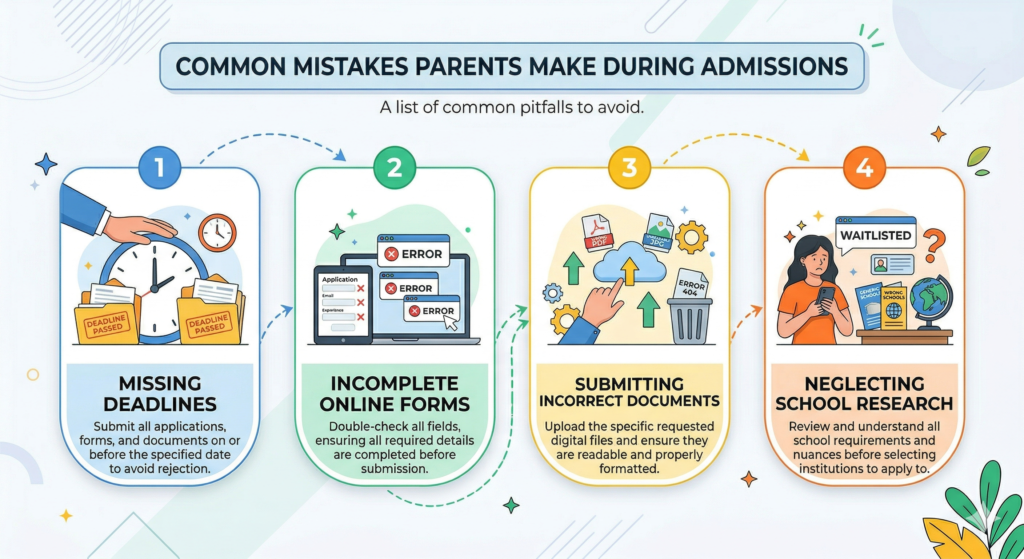
Here are some mistakes parents often realize too late during CBSE School Admission 2026:
Applying to only one school
Even strong applicants face unpredictable outcomes.
Missing deadlines
Forms close quickly.
Incomplete documentation
Missing papers slow the process dramatically.
Ignoring school culture
Some schools focus heavily on academic competition. Others emphasize holistic learning.
Parents sometimes discover this difference only after admission.
Waiting too long to start
This is probably the most common mistake.
Admissions feel distant until suddenly they aren’t.
Fees and Financial Planning
School fees vary widely across CBSE institutions.
During CBSE School Admission 2026, parents usually encounter several types of fees:
• Admission fee
• Annual charges
• Tuition fee
• Development fee
• Activity charges
• Transport fee
Some schools also require:
• Security deposits
• Smart class fees
• Uniform and book packages
It helps to ask schools for a full annual cost breakdown rather than focusing only on tuition.
Because sometimes hidden costs quietly add up over the year.
Financial planning makes the admission decision much clearer.
Conclusion
In the end, CBSE School Admission 2026 is not just an administrative process. It’s a moment where parents pause and think about what kind of learning journey they want for their child.
The forms matter. The deadlines matter. The documents definitely matter.
But beneath all of that sits a simpler hope.
A classroom where curiosity grows.
A teacher who notices potential.
A school environment where a child slowly builds confidence… year after year.
Admissions can feel stressful. Sometimes unnecessarily so. But once the process ends and the first day of school arrives, things become quieter.
Children adapt quickly.
Parents slowly relax.
And the long admission checklist fades into something that almost feels small.
Just the first step of a much longer story.
FAQs
1. When will CBSE School Admission 2026 start?
Most schools begin CBSE School Admission 2026 applications between November 2025 and January 2026, especially for nursery and primary classes.
2. What is the age requirement for nursery admission in CBSE schools?
For most schools, children must be at least 3 years old by the official cut-off date specified by the school.
3. Do CBSE schools conduct entrance exams for admission?
For nursery and primary classes, schools usually conduct interaction sessions rather than exams. For higher classes, written tests may be required.
4. What documents are required for CBSE School Admission 2026?
Common documents include birth certificate, address proof, previous school records, transfer certificate, photographs, and identity proof of parents.
5. Can students transfer to CBSE schools in higher classes?
Yes. Students can apply for admission in higher classes if seats are available and they meet eligibility requirements, including academic records and transfer certificates.